|
|

What's wrong with bicycle helmets?by Michael Bluejay • Original: 2005 •
Last update: April 2025 Summary
|
How helmets HELP
|
How helmets HURT
|
A study at the University of Bath showed that motorists gave less room when passing helmeted cyclists vs. unhelmeted ones. Unhelmeted cyclists seem more vulnerable, so drivers give them a wider berth, making the unhelmeted cyclists more likely to get hit. The researcher was actually struck twice on his bicycle when conducting the study, both times while wearing a helmet.
Other research shows that cyclists who wear helmets are more likely to engage in risky behavior, because the helmets make them feel more protected.
Yet another theory is that helmets effectively make the cyclist's "head" much larger, so with a bigger head a falling cyclist is much more likely to slam it against the road or a car (causing traumatic brain injury because the brain is still slammed against the skull), or possibly even breaking the cyclist's neck.
Patrick Goetz points out another possible problem with helmets:
With some trepidations, I've actually been wearing a bicycle helmet for recreational road biking, However, [a recent car-bike] accident points clearly to one of the problems with helmet usage: I can no longer hear cars coming up behind me since I've started wearing a helmet. It's quite unsettling to be biking down a quiet rural road and suddenly have a giant, noisy pickup blast by completely unanticipated. There's something about how the wind passes through the air vents that greatly attenuates sounds from the rear (and perhaps otherwise).These things could explain why we don't see any reduction in cyclist fatalities when helmet use goes up: helmets could be saving some cyclists but killing others.
The main helmet safety claim is B.S.
Most of us have heard that "bicycle helmets can prevent up to 85% of head injuries". But in the study that figure came from, not a single helmeted cyclist had a collision with a motor vehicle! The study was roundly criticized in the Helmet FAQ by Vehicular Cyclist and by CycleHelmets.org, which states:
This paper is by far the most frequently cited research paper in support of the promotion of cycle helmets. It is referred to by most other papers on helmets, to the extent that some other papers, and most helmet promotion policies, rely fundamentally upon the validity of its conclusions.The claims that helmets reduce head injuries by 85% and brain injuries by 88% come only from this source, yet are quoted widely as gospel by people who know nothing more about cycle helmets. The prospect of achieving such massive reductions in injuries to cyclists lies at the root of helmet promotion and mandatory helmet laws around the world.
Those who have taken the trouble to analyse the paper in detail, however, have found it to be seriously flawed and its conclusions untenable. (more...)
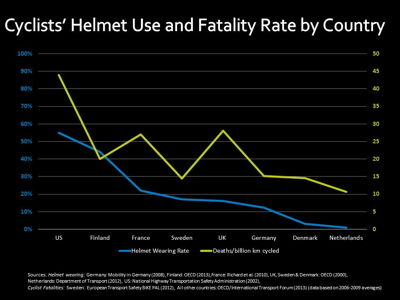
Countries with the highest helmet use have the highest fatality rate for cyclists
The chart show that countries with the most helmet use also have the most head injuries. This is so important that it bears repeating: countries with the highest helmet use also have the highest rate of cycling fatalities. And of course the converse is true: cycling fatalities are much lower in countries where cyclists don't wear helmets very much.
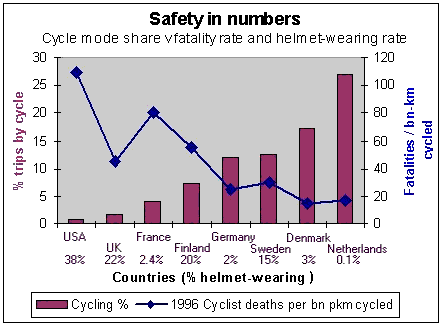 If
this result surprises you, it shouldn't. Above
I've already detailed many reasons why helmets don't really
help.
If
this result surprises you, it shouldn't. Above
I've already detailed many reasons why helmets don't really
help.
Focus on helmets results in abuse of unhelmeted cyclists
It's funny how dramatically perceptions have changed in recent times. As recently as the 80's virtually nobody wore helmets, and no one thought anything of it. But today cyclists are considered stupid and irresponsible if they don't do something that nobody did the first 80 years that cycling was around. Today some motorists feel it's their obligation to scowl and yell "Get a helmet!" at unhelmeted cyclists.
And this brings up another point: The motorists who are so insistent that cyclists wear helmets aren't wearing helmets themselves. This isn't silly: crash helmets could potentially save more lives for motorists than cyclists. About 38,000 motorists die on U.S. roads every year compared to fewer than 700 cyclists. If helmets are good for cyclists, they ought to be great for drivers and passengers. Why is nobody banging the drum about this? After all, helmets save lives, right?
Focus on helmets results in helmet laws, which making cycling less safe
Yet another problem with the focus on helmets is that they encourage state and local governments to enact helmet laws. But while something might be a good idea, that doesn't mean that not doing it should be a criminal offense. It's a good idea to brush your teeth. Should you have to risk arrest if you don't?
The main problem with a helmet law is that it ignores the unintended consequences. If a city passed a helmet law and the only thing that changed was that more cyclists started wearing helmets, then there might be a public safety benefit and no downside. But that's not the only thing that happens when a helmet law gets passed. The most significant result of a helmet law is to discourage cycling. That's because many would rather quit biking than have to wear a helmet, and because a law promotes the idea that cycling is an incredibly dangerous activity. Reductions in cycling by 33% to 50% are typical in places where helmet laws have been passed. (CycleHelmets.org, Cycle-Helmets.com)
Ironically, helmet laws thus make cycling more dangerous, because fewer cyclists on the road means that motorists are less used to seeing cyclists. It's no surprise that the countries with the most cyclists have the lowest rate of injuries per cyclist. Helmet laws ensure that the rate of injury per cyclist goes up. In fact, helmet laws make driving and walking more dangerous, because when people stop biking, they start driving, and it's cars & SUV's that kill other motorists and pedestrians, not bicyclists.
There are yet other problems with helmet laws. In some communities police have used helmet laws as an excuse to target minority kids. In Austin the last time anyone checked, over 90% of the no-helmet tickets given to kids went to black and Hispanic kids.
Once something normal suddenly becomes against the law these kinds of excesses can occur. In Palm Beach County, Florida a sheriff's deputy handcuffed a nine-year-old boy for not wearing the obligatory helmet.
But one of the biggest problems with helmet laws is that the shift the blame onto the cyclist in car-bike collisions, even if the motorist was clearly at fault. The idea is that if a cyclist gets hit by an at-fault motorist, it was the stupid cyclist's fault for not wearing a helmet. This is no exaggeration; this exact opinion has been promulgated by the defense in countless court cases, effectively denying cyclists and their families justice against at-fault motorists. When Ben Clough was killed while bicycling in Austin both the police press release and the article in the local paper made sure to point out that Ben hadn't been wearing a helmet. What they didn't point out at all was that the driver who killed him ran a red light to do so, and as the police report said (which I obtained a copy of), the driver admitted she "had been drinking". The driver was not arrested, and didn't even get a ticket for running the red light, prompting me to comment, that the best way to avoid getting a ticket for running a red light, is to kill an unhelmeted bicyclist while you do it. (more on cycling justice issues)
BicycleAustin has a whole laundry list of arguments against mandatory helmet laws.
Pages referenced in this article, and other resources
- How to not get hit by cars
- CycleHelmets.org reviews the literature about helmet efficacy
- Helmet laws reduce the number of cyclists
- Vehicular Cyclist's Helmet FAQ
- New York Times article questioning the effectiveness of helmets
- Deputy handcuffs 9-year-old for not wearing helmet
- Minority kids more likely to get no-helmet tickets
- Lack of justice for bicyclists
- Safety statistics
|
Book:  The Urban Cycling Manual dismantles the urban cycling experience and slides it under the microscope, piece by piece. Author Robert Hurst discusses how, in America, bicyclists were an afterthought at best when our cities were planned and built, and today are left to navigate through a hard and unsympathetic world that was not made for them--like rats in a sewer. Yet, with the proper attitude and a bit of knowledge, urban cyclists will thrive in this hostile environment. The primary concern is safety, but this book goes well beyond the usual tips and how-to, diving in to the realms of history, psychology, sociology, and economics. It empowers readers with the Big Picture of urban cycling--and gives urban cyclists many useful insights to consider while pedaling the next commute or grocery run. Riding a bike in the city will never be the same. —by the publisher |
Read our guide about how to bicycle safely.
Fan Mail
Splendid! I have been commuting to work year round for several years, and have come to many of the same conclusions you have. You put things very clearly, and there are a few points I hadn't thought of--thank you! I'm going to pass this info around. --Ron Grosslein, Amherst, MA
I would like to say that your site is absolutely terrific. From the title to the last word, it is logical, sensible, and utterly devoted to what should be every cyclist's number-one priority: avoiding death and injury. Way to go! -- Phil Hickey, Boulder, CO
I'm saved! I have got to tell all my friends about this site! (Both biking and non-biking.) Seriously, great advice and great graphics. I am going to try to get our club webmaster to link to you. -- Gerry Maron Carolina Cyclers; Palmetto Cycling Coalition
Reprint & Link Permission
I'm happy to share the information on this site with others at no cost. Permission to reprint How to Not Get Hit by Cars is given freely, subject to the following provisions:
- Linking. Feel free to link to us. The direct url is http://BicycleSafe.com. Here's a list of sites which link to us. If you'd like to link with a banner, feel free to use the How to Not Get Hit banner at the top right of this page.
- Reproduction on websites. Feel free to reproduce the above content on your website, with or without modification. Please link back to this page in the credits of your page. (And let me know if you'd like me to link back to you.)
- Reproduction in printed form. Feel free to reproduce this content in printed form (newsletter, ride brochure, etc.), with or without modification, but please (1) list BicycleSafe.com OR Michael Bluejay in the credits, AND (2) please send a printed copy to Michael Bluejay, PO Box 8600, Austin, TX 78713-8600. Thanks!
- Your publication must be free. You're free to republish this info and redistribute it for free, but you can't charge for it. Newsletters that go out only to paid members of a cycling club are okay.
The contents of BicycleSafe.com are Copyright ©1998-05 by Michael Bluejay and may not be sold for profit.
Safe Road Riding Game/Quiz
The Pennsylvania Dept. of Transportation has an excellent Safe Road Riding Game/Quiz. Most bike safety stuff I see tells you little more than to wear your helmet and follow the law -- as though it were that easy to be safe. But PennDOT's quiz presents real-world scenarios: How do you avoid that car door opening in front of you? What do you do when you're approaching a sewer grate? Good stuff.
Links
See the other sites which link to us.
Note to "Effective Cycling" fans
If you're about to send me an email telling me how stupid the advice on this site is, please save yourself the trouble. Trust me, I've heard all the arguments before (ad nauseum) and I simply disagree. I never write to EC websites to complain that I don't like their advice, so there's no need for you to complain about mine. (Here's more about the the difference of opinion for those wondering what the fuss is about.)
Disclaimer
I have developed this site to provide what I believe is very good advice to help you avoid getting hit by cars. But of course, bicycling will never be 100% safe, and I can't guarantee you won't get hit by a car, even if you follow all the advice on this page. (Naturally, I believe if you follow this advice you will be much less likely to suffer a collision than if you ignore it.) Ultimately, you are responsible for your own safety.

| |||||
|